JConnelly Insights
Young Workers Should Reconsider Fund Allocation
In last week’s blog post I discussed changing trends
among older American investors, who are increasingly using financial technology and moving from more traditional, safer assets to riskier ones like stocks. My predictions included the incorporation of more aggressive growth investments in the conventional “core and satellite” approach for older clients’ portfolios.
I also touched on the old “100 minus your age” axiom for asset allocation, which has been the focus of a few studies covered in a ThinkAdvisor article I recently read. In the past, this simple rule of thumb has guided investors by suggesting they hold a percentage of stocks equal to 100 minus their age in order to gradually reduce risk with age. However, it has lost traction given structural changes in pension, social security, and interest over time.
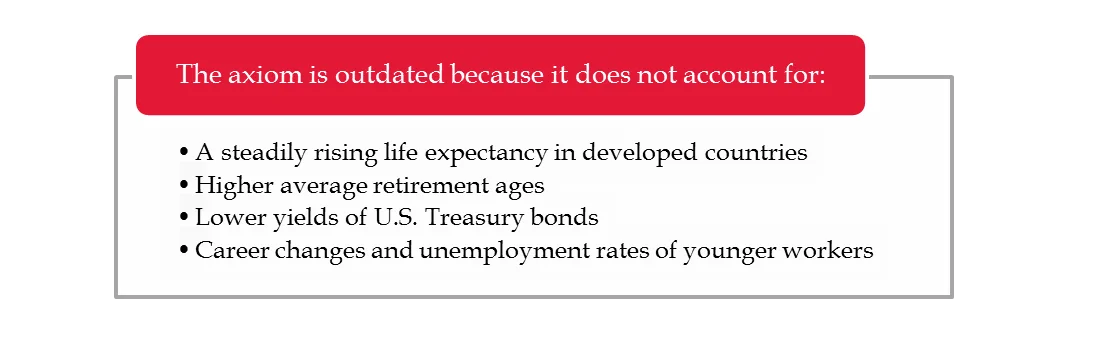 Given these shifts, young workers are more likely to gamble away their savings while retirees reap fewer benefits from safer investments and rising interest under this rule of thumb. A more equal asset allocation strategy for both younger and older investors would likely be more suitable for today’s economic parameters.
Alternative guidelines now range from an updated 110 or 120 minus your age rule to Research Affiliates’ suggested “starter portfolio”—equal thirds of bonds, stocks, and diversified inflation hedges, described in their latest investor newsletter. Furthermore, researchers Arnott and Wu cite a Fidelity study reporting that 41% of 12.5 million retirement plan participants between ages 20 and 39 cashed out part or all of those assets when switching jobs and incurred tax penalties.
Younger workers are more vulnerable to unemployment, especially in recessions, and should consider more prudent asset allocation to avoid plummeting investments on top of the potential of being laid off.