JConnelly Insights
Investment Trends of Older Americans are Shifting
The old axiom about re-adjusting your portfolio to represent your age in bonds versus stocks overall has significantly changed, as a majority of investors close to retirement or in retirement can no longer depend solely on their pensions, social security and interest to maintain their lifestyle.
Additionally, a sharper contrast between older investors and millennial investors is developing as the latter group is investing less – and later in life – than preceding generations.
One aspect of investing in which the two age groups are converging is the use of online platforms for managing finances.
Case in point: an article in Investment News posted in May reported an increase in online asset management for investors over 50, stating that half of them claimed to be self-directed. However, this “robo-advisory” approach often lacks insightful long-term planning as well as a trusted, qualified person behind the research. Another emerging trend is the use of both traditional advisors and robo-advisors as complementary services. Financial advisors increasingly use the internet and embrace algorithms to communicate and work with clients while still regularly meeting with them in person.
A recent Fox Business news segment outlined the latest trends in asset allocation by age group. Past advice given to older investors centered on being cautious, but these numbers show how older Americans are going against the traditional ways of investment:
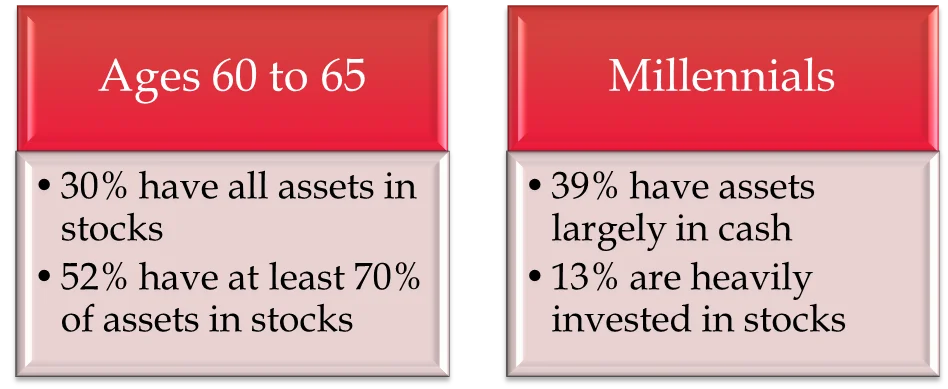
The gap between the two groups is partially explained by lower household wealth for younger Americans compared to a few decades ago, causing a delay in asset accumulation and investing for millennials.
Furthermore, the fact that 75 percent of Americans over age 65 now rely on investments—many of them on the riskier side—to supplement income, accounts for such a contrast. (Click to Tweet)
That said, I predict that…
- Advisors will continue to use a “core and satellite” approach to client portfolios, with the core being replaced by some form of guaranteed income (such as RetireOne) to allow for aggressive growth investments in the rest of the investor’s portfolio.
- The robo-advisor and traditional advisor will continue to meld and the client will be the ultimate beneficiary.
What do you think about the “bolder” approach to investing that older Americans are taking? We’d love to hear from you!